By Scott Aurnou
Using computers and mobile devices largely concerns storing, retrieving and transferring information more efficiently. Two basic ways to store and access information is via print (like a newspaper, book, or a patient’s written chart or x-ray film) or electronically (reading that same newspaper or book on the Web or a Kindle, storing the chart or x-ray as a file on your office’s computer network, etc.). These are sometimes referred to as static media or digital/electronic media, respectively. Unlike static media, digital/electronic media requires power to access and read, though it’s also easier to search, store and transfer and, of course, it’s always possible to print an electronic record to generate a paper copy.
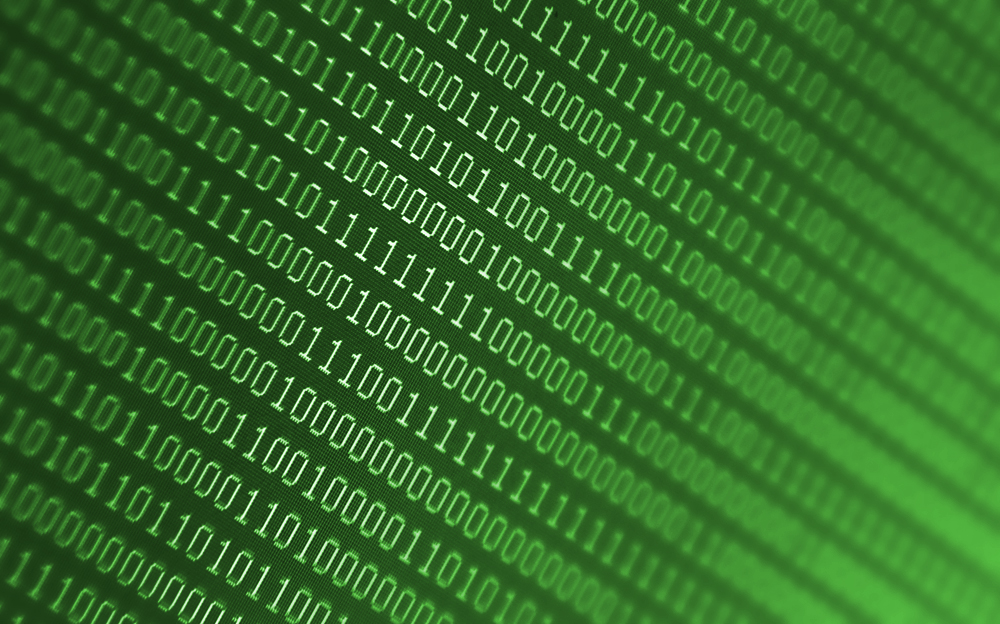
A somewhat stylized visual of binary code
With a wide range of businesses increasingly keeping office, client, customer and patient information electronically – rather than using file cabinets stuffed to the gills with paper – this begs the question: how is that data actually stored? At its most basic level, all electronic data is reduced to seemingly endless lines of 1s and 0s called binary code. Each individual 1 or 0 is referred to as a ‘bit.’ The smallest number of bits that can be read electronically is eight (i.e., 01001010). This is referred to as a ‘byte’ and each one holds only a tiny amount of information. It varies a bit depending on the program using it, though a byte might hold a number, a letter, or perhaps a small word or two. Naturally, bytes are grouped together for data storage and various computer programs. About a thousand (it’s actually 1,024) bytes is called a kilobyte. About a thousand kilobytes is called a megabyte and about a thousand megabytes is referred to as a gigabyte. In case you’re curious:
A kilobyte = 1,024 bytes
A megabyte = 1,048,576 bytes
A gigabyte = 1,073,741,824 bytes
The amount of files a gigabyte can hold will vary a bit, depending on the type of file is being stored and perhaps its video, audio or print quality, but a conservative figure sometimes given is that a gigabyte can hold approximately 75,000 pages of text. That means a computer with a 200-gigabyte storage capacity – not particularly large by today’s standards – can contain about 15 million pages of data.
Read more ›