Your GPS Can Pose a Security Risk. Yes, Really…


Computer Security Tip of the Week

Scott Aurnou – Strange as it may sound, your GPS can actually pose a security threat. Learn more about it (and a simple way to prevent it) here.

If you enjoyed this video, you can see more on TheSecurityAdvocate YouTube channel (and subscribe if you like).

Tagged with: , , ,
Posted in Security Tip of the Week

Top Questions to Ask Before Your Business Stores Company Data in the Cloud

Cloud Computing ConceptBy Lauren Mack

If you own a business, your IT staff is likely one of many across the globe who are slowly convincing businesses owners and managers that storing data in “the cloud” is the future. He or she probably pointed out that hiring a third party to store your company’s data will allow you and your employees to access it from anywhere via the Internet, cut costs, and may help you avoid a great deal of hassle should something happen to the company’s on-site data storage facilities. But before you give the green light to your resident tech geek to start outsourcing your company’s data storage to the cloud, there are several legal considerations that you should be aware of prior to making the big move. Here are the five major questions that you as a business owner or manager need to know the answers to BEFORE signing a contract with a cloud service provider:

1. Who will have access to your business’ data?

The first piece of information that you need to obtain from potential cloud service providers is whether a third party will be processing, storing, or transmitting your company’s data. In some cases, a cloud service provider may not actually own the servers where your data will be stored. The cloud service provider may subcontract out the storage of data, and that subcontractor may in turn be subcontracting out storage services, and so on. Other cloud service providers may offer bundles of cloud software services that seem to all be part of one application to the user, but are actually made up of several subcontractors that operate the different services and the associated data storage. The more subcontractors that are involved, the more legal risk your company will likely be subject to because it can never know where the data is physically located and how well it is protected at any one time.
Read more ›

Tagged with: , , , , , , , , , ,
Posted in Cloud Security, Guest Posts, Privacy Issues

What is ‘Spoofing’ & Who REALLY Sent You That Weird Email?


Computer Security Tip of the Week

Scott Aurnou – Thanks to a process called ‘spoofing,’ people (or machines) calling or emailing you can pretend to be someone else in order to trick you. Learn more about it here.

If you enjoyed this video, you can see more on TheSecurityAdvocate YouTube channel (and subscribe if you like).

Tagged with: , , , , , ,
Posted in Fraud & Scams, Laptops & Desktops, Security Tip of the Week

The Phishing Gallery – May 2013

By Scott Aurnou

‘Phishing’ attacks are designed to steal your personal, financial and/or log in information. This can be done in a few ways, including via email or text message (referred to as ‘smishing’). They often contain links to websites that look legitimate but are really there to steal your account log in information or host malware ready to attack your computer. These emails and messages can also be used to lure you into contact with scam artists posing as potential clients or officials offering to release substantial funds to you if only you would be so kind as to give them detailed personal information or a sum up front. Phishing attacks are generally designed to make you take action by either frightening or tempting you. Some of them are actually very well crafted. Some not so much. And some border on the ridiculous. Each month at The Security Advocate, we will present a few examples, along with explanations of what to look out for to avoid falling victim to one of the scams.
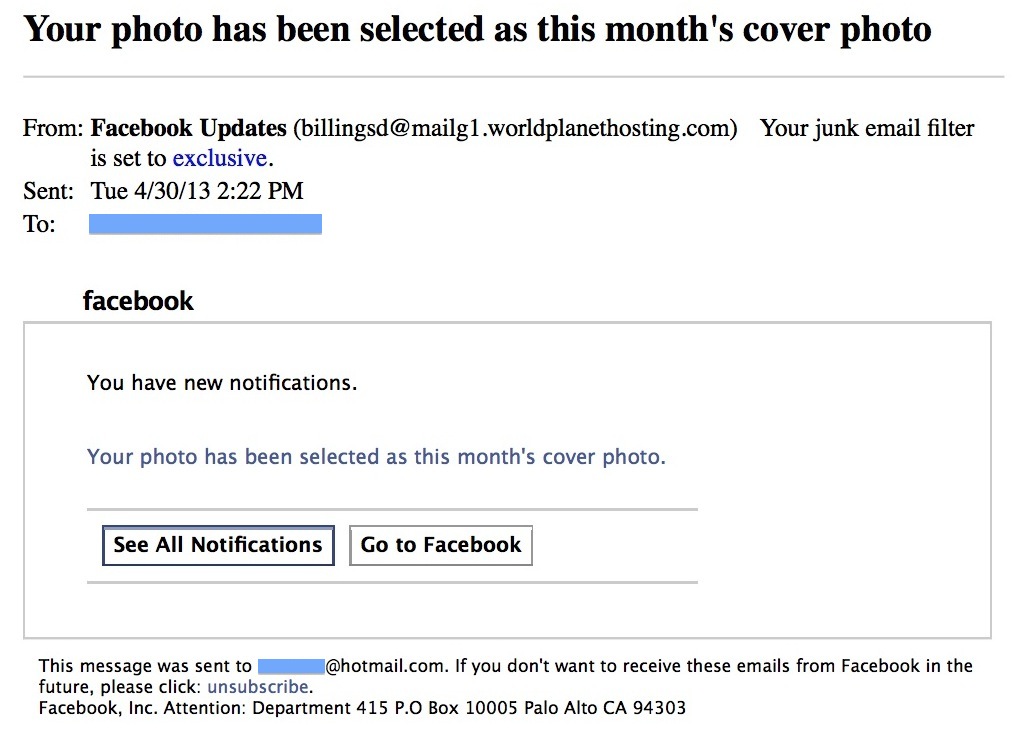
Facebook 'Cover Photo' Message
This attack is intended to tempt you into taking a peek at your new ‘Facebook Cover Photo’ – it’s human nature, as we’re all curious, though Facebook doesn’t actually have those. If it did, you can rest assured you would see it when you logged in. If nothing else, the mismatched name and email address in the ‘From’ field give it away as the product of a botnet (i.e., definitely not Facebook). Faking a email sender’s name is unfortunately pretty easy for scammers to do – it’s a process known as ‘spoofing.’ Avoiding this type of phishing attack is relatively simple: whenever you receive an email notification from any social media site, just log in to the site directly to read it. Never use the web links found in the notification emails, and you won’t have to find out the hard way that they’re not what they appear to be.
Read more ›

Tagged with: , , , , , , , , ,
Posted in Fraud & Scams, Laptops & Desktops

What If Your Computer or Phone is Lost, Stolen or Just Breaks?


Computer Security Tip of the Week

Scott Aurnou – Backing up your electronic data is fairly easy to do and can be done a number of ways. If your computer, phone, tablet, camera, etc. is lost, stolen, just stops working or there’s even a natural disaster – and you haven’t backed up your files correctly – everything, including your documents, spreadsheets, presentations & other work product, messages, pictures, video clips, etc. will be gone forever. Before that happens, learn more about backing up your files here.

Websites referenced in this video include:
Apple iCloud: https://www.icloud.com/
Microsoft SkyDrive: https://skydrive.live.com/

If you enjoyed this video, you can see more on TheSecurityAdvocate YouTube channel (and subscribe if you like).

Tagged with: , , , , , , , , ,
Posted in Laptops & Desktops, Security Tip of the Week, Smartphones & Tablets
Twitter: saurnou
TheSecurityAdvocate Youtube Channel